What Is Infrared Induction Technology and Why It's Better Than Regular Induction for Indian Kitchens
Share
If you've ever looked at induction cooktops and hesitated because your old kadai or tawa won't work on them — this article is for you.
There's a newer, smarter technology called infrared induction that solves the single biggest problem with standard induction cooktops. And once you understand how it works, you'll wonder why you waited this long to make the switch.
The Problem With Standard Induction Cooktops
Standard induction cooktops work using electromagnetic fields. They require cookware made from magnetic materials — cast iron or magnetic stainless steel — to function. If you place a regular aluminium pressure cooker, a copper vessel, or a non-magnetic stainless steel pot on a standard induction cooktop, absolutely nothing happens.
For most Indian kitchens — stocked with aluminium pressure cookers, brass vessels, old steel tawas, and clay pots — this is a dealbreaker. Switching to standard induction means replacing your entire cookware collection. That's an expensive and unnecessary hassle.
How Infrared Induction Is Different
Infrared induction cooktops use a different heating mechanism entirely. Instead of creating a magnetic field, they generate infrared radiation that heats the glass surface itself, which then transfers heat directly to whatever is placed on it — just like a gas flame heats the bottom of your pot.
The result? It works with every flat-bottom pot and pan you already own. Aluminium, steel, copper, clay — everything. No cookware upgrade required.
This is why infrared induction is particularly well-suited for Indian cooking, where cookware variety is enormous and replacing it all simply isn't practical.
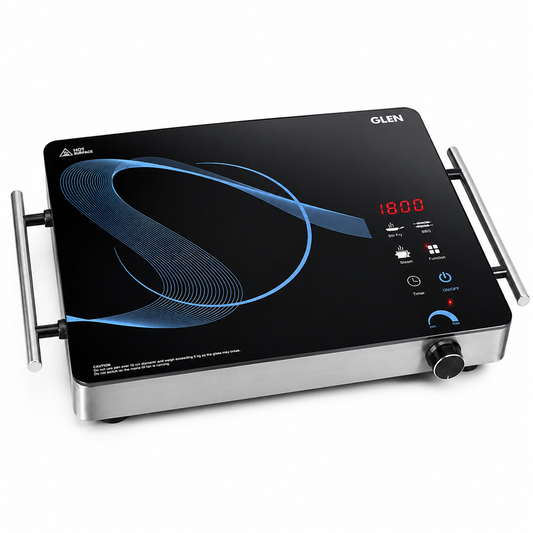
Glen Infrared CookTop SA-3072IR: Built for Indian Kitchens
The Glen SA-3072IR brings infrared technology to an affordable, well-built cooktop designed specifically with Indian cooking needs in mind.
Universal cookware compatibility. Works with all flat-bottom vessels — your pressure cooker, your tawa, your kadai, all of it.
Preset functions for Indian cooking styles. The Stir Fry mode is perfect for tadka and sautéing. Soup & Steam handles your dal and sabzi. BBQ mode works with the included stainless steel grill rack.
Stainless steel frame — not cheap plastic. Glen has built this to last in a busy Indian kitchen.
Touch sensor controls with a digital display. Clean, intuitive, no knobs to break or grease to accumulate in.
4.5kV surge protection — critical in India where power fluctuations are common. This protects the electronic brain of the cooktop from voltage spikes.
180-minute timer so you can put something on to cook and step away without worry.
Is Infrared the Same as a Gas Stove?
In terms of cooking experience — very close. The heat distribution is similar, the response time when you change temperature settings is fast, and you can use it for every Indian cooking technique: frying, boiling, steaming, slow cooking, and even barbeque with the included rack.
The main difference is there's no open flame — which actually makes it safer, especially in homes with children or elderly family members.
The Bottom Line
If you want to move away from LPG dependency but don't want to replace your cookware or change how you cook — infrared induction is the answer. The Glen SA-3072IR at ₹5,100 is one of the best value options available in India right now.